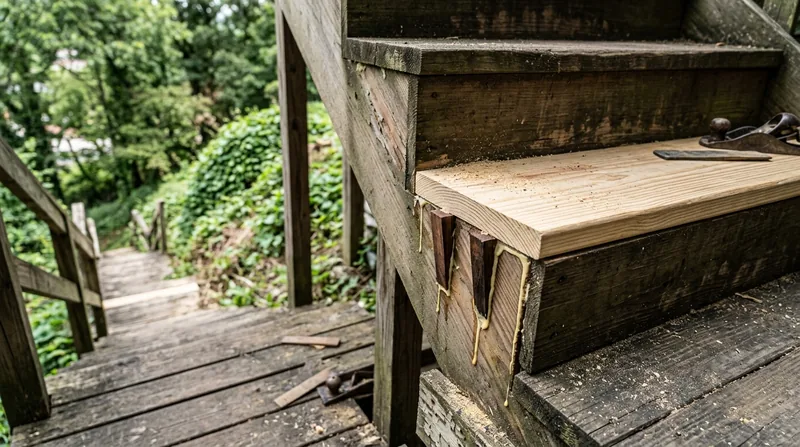




Atlanta's historic neighborhoods, from the Victorian mansions of Inman Park to the Craftsman bungalows of Virginia-Highland, are home to staircases that have carried families for over a century. Many of these homes feature original wood stairs, period railings, and balusters that define their character but have worn loose, creaked under foot, or begun to show the effects of Atlanta's humid subtropical climate and the seasonal wood movement that comes with it. Stair and railing repair in Atlanta requires understanding how Atlanta's red clay soil, dense tree canopy, and year-round moisture affect wood grain and joinery. We repair and rebuild treads, stringers, balusters, and newel posts, restore period railings to their original profiles, and install code-compliant handrails and attic ladders that respect the integrity of older homes. Whether you're in Druid Hills, Candler Park, or one of the outer suburban neighborhoods, squeaky treads and loose banisters are a sign that the stair system needs attention before the problem compounds into structural issues.
Why Stair and Railing Safety Matters in Atlanta's Older Homes
Staircases are high-traffic, high-stress elements in any home, and in Atlanta's older housing stock, the combination of age, moisture, and wood movement creates specific failure modes that homeowners encounter repeatedly. A squeaky tread often signals that fasteners have loosened as the wood has expanded and contracted with seasonal humidity swings. A loose baluster or newel post is not merely cosmetic, it's a safety concern, especially in homes with children or older adults. Atlanta's climate, with its hot humid summers and mild winters, drives continuous dimensional change in wood, and staircases, which are built with multiple intersecting grain directions, experience uneven movement that stresses joinery over decades.
- We re-fasten treads and risers to stringers using screws and construction adhesive to prevent future movement and eliminate squeaks.
- We repair or replace balusters and newel posts that have cracked, split, or loosened due to wood movement or impact damage.
- We restore period railings and handrails to match the original design while ensuring they meet current code load requirements.
- We inspect stair stringers for wood rot or dry rot, which can weaken the structural integrity of the entire staircase and require sistering or replacement.
Addressing stair issues early prevents the kind of cascading damage that turns a simple tread repair into a complete stringer replacement.
Key info: Atlanta's humidity creates seasonal wood movement that loosens fasteners in staircases. A loose baluster or squeaky tread is often a sign that the stair system needs re-fastening or minor repair before larger structural issues develop. Check your stairs annually, especially in spring and fall when humidity transitions are sharpest.
For more detail on how wood responds to Atlanta's climate and moisture, see our wood rot and dry rot repair page.
How We Repair and Rebuild Stairs and Railings in Atlanta
Our approach to stair repair is methodical and grounded in understanding how the staircase was originally built and how it has moved and settled over time. We begin with a detailed inspection of the entire stair system, from the top newel post to the bottom landing, identifying which components are loose, cracked, or damaged and which are structurally sound and worth keeping. We use traditional joinery and modern fastening techniques to restore function and safety while preserving the original character of the staircase, especially in historic homes where period details matter.
- We inspect the full stair assembly, including stringers, treads, risers, balusters, newel posts, and railings, to identify loose fasteners, cracks, splits, and wood rot.
- We re-fasten loose treads and risers using corrosion-resistant screws driven from underneath or from the sides, paired with construction adhesive to prevent future movement.
- We repair cracked or split balusters by gluing and clamping, or replace them with new wood turned to match the original profile if the damage is too severe.
- We repair or replace stair stringers that show wood rot or dry rot by sistering a new section of Douglas fir or redwood alongside the damaged area, or by full replacement if the rot is extensive.
- We install new handrails, balusters, or newel posts that match the period style of the home while meeting current building code load requirements for handrail grab strength and baluster spacing.
In a Victorian home in Grant Park, we recently re-fastened a loose closed stringer on a basement staircase and replaced three split balusters on the main floor stairs. In Kirkwood, we sistered a section of the stringers on an interior staircase and installed new handrails that matched the original turned balusters. The work took two days and preserved the original character while restoring safety.
Example: A Craftsman bungalow in Candler Park had squeaky main-floor stairs and a loose newel post. We re-fastened the treads, tightened the baluster connections, and reinforced the newel post base with hidden brackets. The owner noticed the difference immediately, and the stairs have remained quiet and solid for years.
For related structural carpentry work, see our framing and structural carpentry page.
Stair and Railing Repair Methods: When to Repair, When to Replace
| Approach | Description | Best for |
|---|---|---|
| Re-fastening | Remove loose fasteners, clean the joint, apply construction adhesive, and drive new corrosion-resistant screws from underneath or sides. | Squeaky treads, loose risers, loose balusters, and minor movement caused by seasonal wood shrinkage and expansion. |
| Crack and split repair | Glue deep cracks in balusters, newel posts, or stringers using waterproof epoxy or hide glue, clamp for 24 hours, and seal the surface to prevent moisture re-entry. | Radial cracks in balusters and newel posts caused by wood movement, and minor splits in stringers that do not compromise structural capacity. |
| Sistering | Attach a new section of Douglas fir or redwood alongside a weakened or partially rotted stringer, rim, or baluster using bolts and construction adhesive. | Localized wood rot or dry rot in stringers, partial loss of cross-section that does not require full replacement, and structural reinforcement of weakened areas. |
| Component replacement | Remove and replace balusters, newel posts, treads, risers, or stringers with new wood turned or milled to match the original profile and joinery. | Balusters and newel posts damaged beyond repair, treads with deep wear or impact damage, stringers with extensive rot, and period railings that need restoration. |
| Handrail and code compliance | Install new handrails, update baluster spacing, and ensure grab strength meets current building code while respecting the period character of the home. | Older homes that lack adequate handrails, have spacing between balusters wider than code allows, or need railings upgraded for safety without losing historic character. |
Stair and Railing Repair Cost in Atlanta: What to Expect
The cost of stair and railing repair in Atlanta varies significantly based on the scope of work, the condition of the stair system, and the extent of any wood rot or damage that is discovered once we begin the inspection. A simple re-fastening job on a squeaky staircase with no structural issues may cost less than a project that requires sistering, replacement of multiple balusters, or restoration of a period railing. We recommend getting two or three estimates so you can compare approaches and pricing before committing to the work.
Most re-fastening and minor repair jobs start at around $600 to $1,200, depending on the number of treads, the accessibility of the staircase, and whether the work is interior or exterior. A staircase with loose balusters, a loose newel post, and squeaky treads in a Craftsman bungalow might fall into this range. If the inspection reveals wood rot in the stringers or significant damage to balusters, costs rise as replacement components are needed. A full stringer replacement or a complete railing restoration for a period home can run $2,500 to $5,000 or more, depending on the complexity and the materials used.
Factors that affect the final cost include the size and complexity of the staircase, the type and extent of damage, the accessibility of the work, whether the home is historic or protected by deed restrictions, and whether your homeowners association has rules about exterior railings or visible modifications. Attic ladders and specialty handrails may have their own pricing based on material and installation complexity.
For a detailed breakdown of pricing across all our services, visit our full pricing overview. Call us at (678) 284-2440 for a free estimate, and we will provide a detailed quote after inspecting your stairs.
Stair and Railing Repair Near Me: What Atlanta Homeowners Should Know When Hiring a Carpenter
Hiring the right carpenter for stair and railing repair means finding someone who understands both the structural requirements of a safe staircase and the aesthetic and historical considerations that matter in Atlanta's diverse residential neighborhoods. Many homeowners in historic districts like Inman Park, Druid Hills, and Virginia-Highland are rightly concerned about preserving the character of their homes while ensuring safety and compliance with current building codes. When you contact a contractor, ask about their experience with period staircases, their approach to repair versus replacement, and their familiarity with local building code requirements for handrails and baluster spacing.
Before you hire, verify that the contractor is fully insured and carries general liability and workers' compensation coverage. Ask for references from recent stair repair jobs, and call those customers to ask about the quality of the work and how the contractor handled unexpected issues like hidden wood rot. If your staircase is exterior or if you are planning to alter a load-bearing element, check with the City of Atlanta or your local building department to understand whether a permit is required. Many structural changes to staircases do require a permit, and requirements vary by location, so it is your responsibility to verify this before work begins. If your home is in a historic district or subject to HOA deed restrictions, ask about those requirements as well, especially if you are planning to replace railings or handrails that are visible from the street.
Get estimates from at least two contractors, and compare their approach to the repair, the timeline, and the warranty or guarantee they offer. The cheapest estimate is not always the best value if the contractor is proposing to replace components that could be repaired, or if they are unfamiliar with period details. A good carpenter will explain what they find during the inspection, show you photographs of the damage, and walk you through why they are recommending repair or replacement for each component.
Ready to move forward? Contact us for a free, no-obligation estimate, and we will inspect your stairs, explain what we find, and give you a clear quote before we begin any work.
Stair & Railing Repair in Atlanta: Pricing Guide
| Service | Price | Details |
|---|---|---|
| Re-fastening and minor tread repair | Starting at $600 | Loose treads, squeaky stairs, and tightened fasteners on small to medium staircases without rot or structural damage |
| Baluster and newel post repair or replacement | Starting at $900 | One to four cracked or loose balusters, newel post reinforcement, or period-matched replacement balusters depending on complexity |
| Stringer repair or sistering | Starting at $1,500 | Localized wood rot in stringers, sistering new sections, or reinforcement of weakened areas; full stringer replacement runs higher |
| Period railing restoration or handrail installation | Starting at $1,200 | Historic railing restoration, new handrails, code compliance updates, and baluster spacing corrections for safety and character preservation |
| Comprehensive stair system repair or full replacement | On estimate | Multiple components requiring repair or replacement, extensive rot, structural concerns, or complete railing overhaul require on-site assessment |
| Estimate and travel | Free | No charge for inspection and estimate; travel included in Atlanta and surrounding service areas; response within 24 hours |
Indicative pricing, the exact cost depends on square footage, finish, and site access. Free personalized estimate within 24h at (678) 284-2440.


